How To Become A Brilliant Writer On Top Of A Day Job
How I Write When Life Gets Crazy

From now on, the Saturday letters will merge with the Monday paid letters. This will allow me to put more effort & care into my weekly posts on top of my incredibly busy life! Enjoy this week’s post!
It’s been a crazy weekend.
For context, since landing a full-time job, I’ve been scheming to move closer to Melbourne’s CBD. And a week ago, an apartment that I’ve been eyeing for years became vacant.
I signed the lease within hours, spun around the room like a crazy dachshund and interrupted my girlfriend’s wine night with a call:
‘Yo, you free to help me demolish my bookshelf this weekend?’
What followed was this crazy sight:
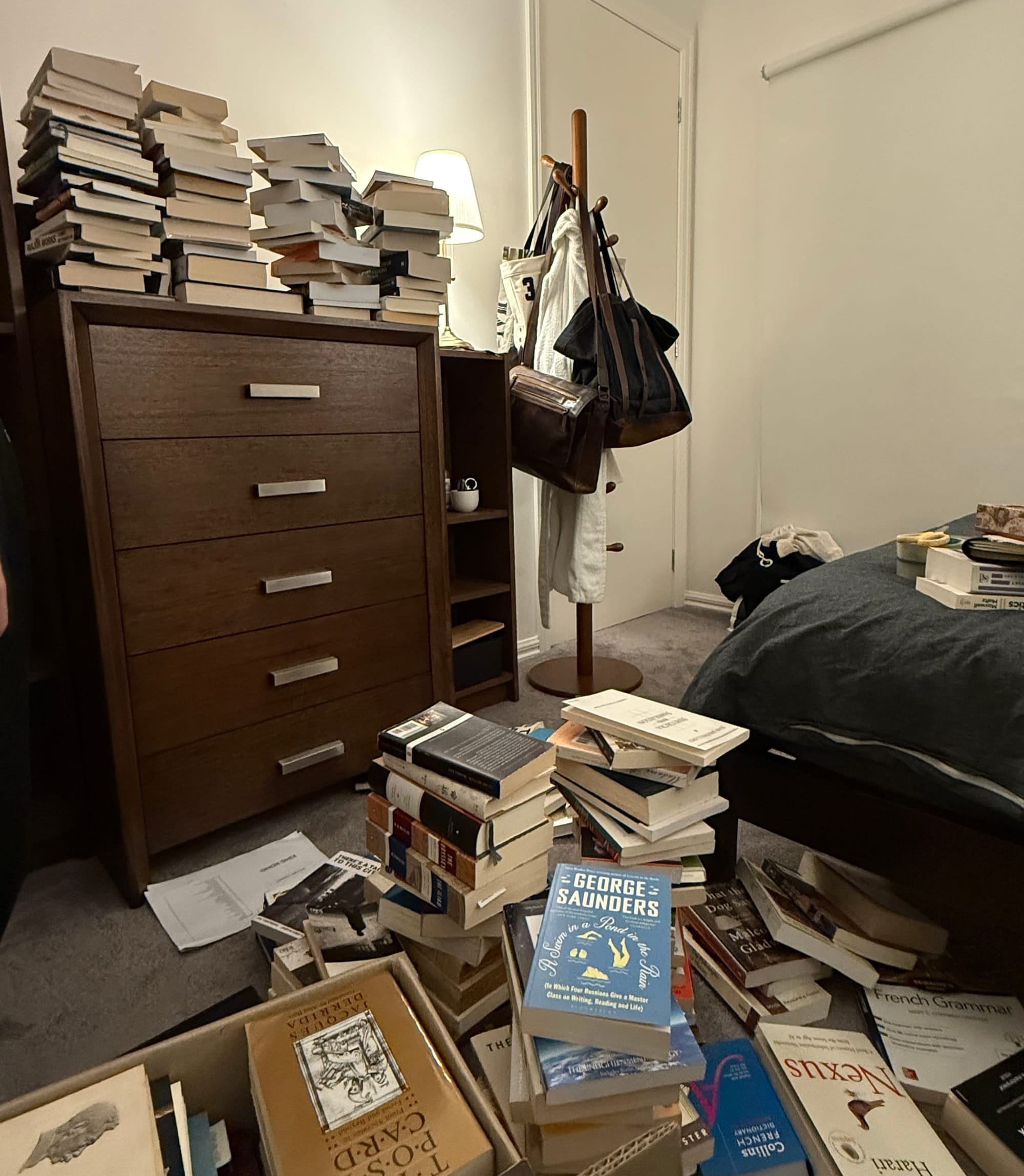
I looked around my room and realised that all this crap on the floor was only 10% of all my collection. And while I was staring at all my books, I realised that I’ve written exactly 0 words this week.
And today’s letter is about just that: how to find time to write when life gets crazy.
My immediate reaction was to drop everything I was doing, strap myself to a chair, put on some Alt-J and bang out this weekly newsletter. But upon reflection, I realised that I’ve been in this spot many, many times throughout my career.
In 2024, I realised that I had to complete a 20,000-word thesis with only 2 months to spare.
In 2025, my publisher only gave me 6 months to turn in an 80,000-word manuscript.
Now, I’m trying to publish 3000-4000 words a week on top of a full-time job.
And for every one of these impossible writing projects, I’ve always followed the same set of protocols to write myself out of the corner. I call it: the sensei protocols.
So today, I’d like to show you how I’m setting it up in real-time to ensure that I don’t end up with another 0-word week ever again.
There’s a good reason why I call it the sensei protocols.
When I’m not at my desk, I practise karate 4 times a week at a local dojo.
Sure, a huge part of my motivation comes from Jackie Chan movies, but another part comes from the kind of people I get to meet when I train.
You get all sorts there: high school teachers, a mother of 2, a 66-year-old retiree, ex-security guards and perhaps the most interesting character of all: a 45-year-old dentist who is also a 6th Dan black belt.
But one thing that all these people have in common is that they found time to train on top of a crazy busy life.
I found this hard to believe at first, so I dipped my toe into the water with only 1 lesson a week when I started. After all, I had to write a book, run a business, make videos, cook a meal and deal with all the crap life throws at me.
But after 2 months of training, I started ramping up my lessons to 3 times a week and was shocked to discover that it had 0 impact on my life during the day.
I wasn’t tired. In fact, I felt more energised throughout the day.
I still had time to run my business, and I became more efficient because I had to head to the dojo straight after work.
And even better: I train better because I see martial arts as a circuit breaker and I always feel mentally refreshed after a night of heavy training.
This made me realise that all the woo-woo we heard from corporate wellness culture was flat-out wrong.
Our minds don’t relax by doing nothing. It relaxes through a change in scenery.
I mean, think about it. What do all after-work activities have in common?
Watching TV = change in scenery.
Going out to the pub = change in scenery.
Scrolling on our phones = change in scenery.
The worst part is that most of these activities aren’t even that relaxing! They’re just there to waste the hours between work and sleep.
So, what I’m proposing here is a bit crazy, but bear with me:
You can see writing as a relaxing change of scenery after a long day at work.
This is the essence of the sensei protocols. If a 45-year-old dentist with brutal hours can find time to become a 6th Dan black belt, what excuse do we have to not write every day?
However, putting this into practice takes a bit of explaining, or you’ll definitely burn out from overwork. So, strap in.
Now, do you want to know the secret to creating a successful newsletter, landing a book deal with Bloomsbury Academic and using my ideas as my greatest assets?
Subscribe to continue reading