How To Add Texture To Your Non-Fiction Writing
Or, how Malcom Gladwell writes about ketchup

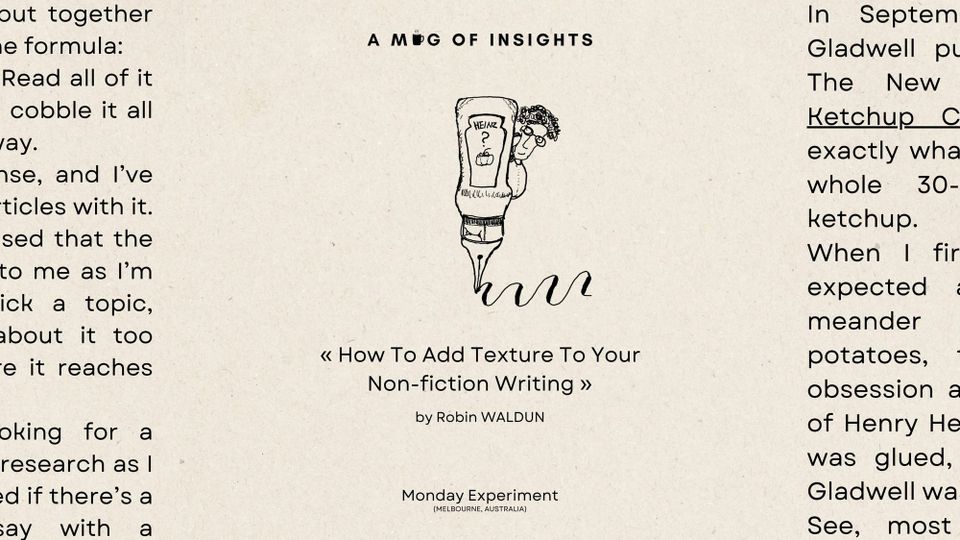
Every essay you’ve ever put together follows a drab, set-in-stone formula:
Topic → Find Research → Read all of it over 50 cups of coffee → cobble it all together in some logical way.
This structure makes sense, and I’ve written my fair share of articles with it. But over the years, I realised that the best ideas usually come to me as I’m writing. Whereas if I pick a topic, research it, and write about it too early, it’ll get stale before it reaches page 2.
So, lately I’ve been looking for a system that allows me to research as I write. I’ve always wondered if there’s a way to write an essay with a disciplined spontaneity that is common in jazz musicians, and I think I found the answer in a 2004 essay in The New Yorker.
This is what I want to share today as our Monday experiment and show you how to use it in your writing.
In September 2004, Malcolm Gladwell published an essay in The New Yorker titled ‘The Ketchup Conundrum’ and it’s exactly what it says on the tin: a whole 30-page essay about ketchup.
When I first read the title, I expected a long and boring meander about tomatoes, potatoes, the American soup obsession and a drab biography of Henry Heinz. But 10 pages in, I was glued, and I noticed what Gladwell was doing.
See, most essays are boring because they are mere presentations of ideas. The idea is already vacuum sealed in a pickle jar, and the writing is as interesting as reading the ingredients list on the back.
But Gladwell is that crazy person who smashes the jar, eats a pickle, gets all excited and sits you down to rant about it. This is Gladwell’s secret sauce: he doesn’t present ideas, but he thinks on the page with you.
This makes sense because the root word for essay is essayer (to try) from the French. In a way, every essay is an attempt to think on the page and doing a ton of research before you write a word defeats the purpose.
And here’s how Gladwell thinks about ketchup on the page.
Subscribe to continue reading