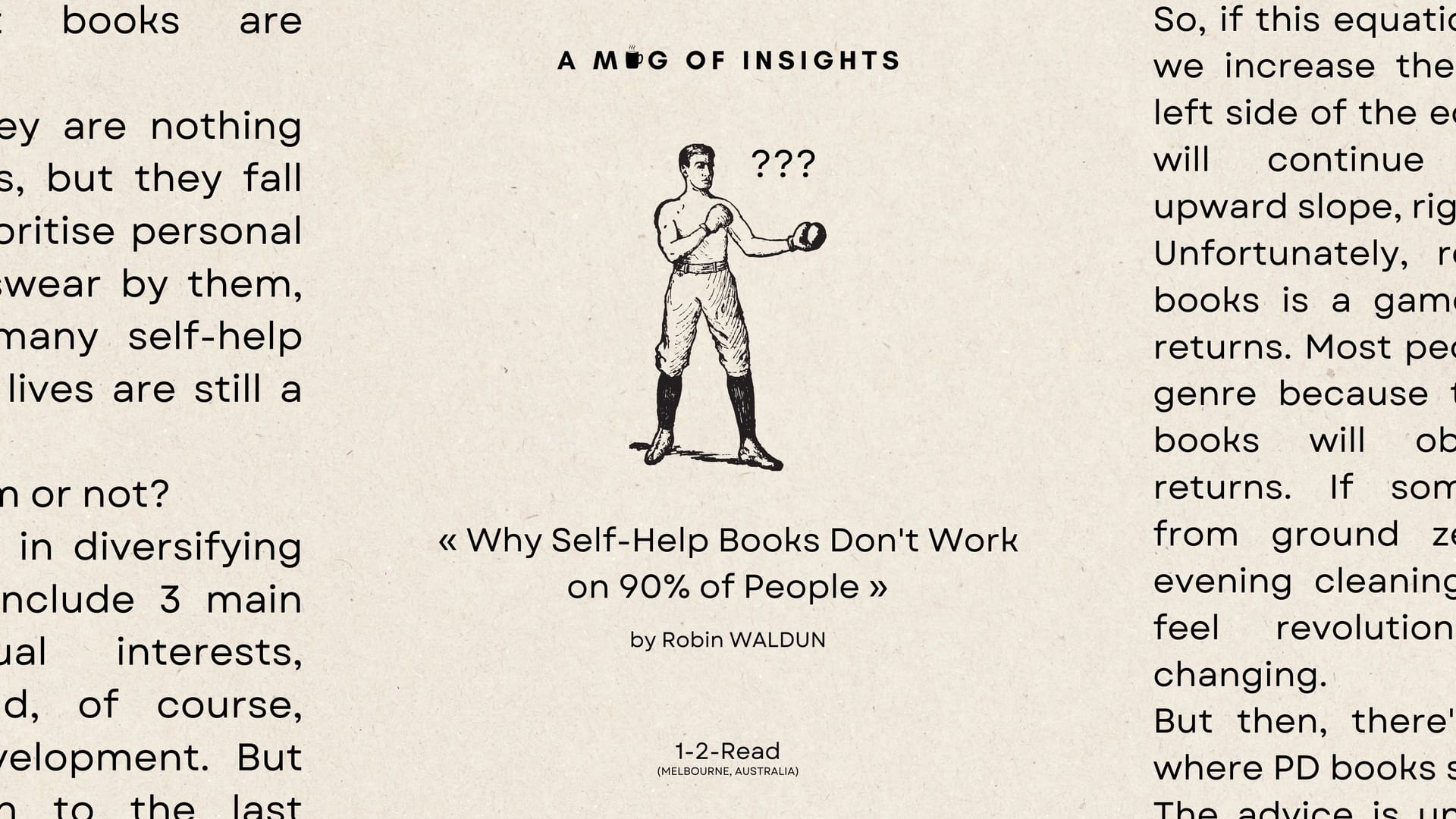
Why Self-Help Books Don't Work on 90% of People
Personal development books are divisive.
Some people think they are nothing but scummy platitudes, but they fall behind people who prioritise personal development. Others swear by them, but no matter how many self-help books they read, their lives are still a mess.
So, should we read them or not?
See, I’m a big believer in diversifying your reading diet to include 3 main categories: intellectual interests, aspirational titles, and, of course, practical personal development. But when it comes down to the last category, most people approach it all wrong.
The standard, Oprah-Winfrey-endorsed approach to personal development books looks something like this:
Great self-help book x Read the damn book = Your life magically transforms.
So, if this equation is true, then if we increase the number on the left side of the equation, our lives will continue towards that upward slope, right? RIGHT?
Unfortunately, reading self-help books is a game of diminishing returns. Most people get into this genre because the first few PD books will observe outsized returns. If someone's starting from ground zero, then yeah, evening cleaning your room will feel revolutionary and life-changing.
But then, there'll come a point where PD books start to feel stale. The advice is uniform, repetitive and preachy. Eventually, people get to the point where reading 50 of these books won't make any difference. This is where we have to stop, take a deep breath, get our asses out of cold plunges and realise that there's a deeper layer to personal development books.
Fundamentally, any practical personal development book (fitness, finance, relationships, etc.) is just a collection of ideas that have the potential to be activated by life experience. Real change happens when the right life experience gets recontextualised with the right ideas, giving you those aha moments that rewire your thinking around finance, relationships, and, if you read my work, learning. From this point onwards, changes will come from a deep inner shift.
But in any case, life experience is always required for the right idea to take part in this change. A great book on investing will make 0 difference in a 5-year-old’s life because they probably don’t even have a bank account. Likewise, reading The Five Love Languages will be a complete waste of time if you’re not in a relationship.
Moreover, reading too many personal development books, too early, will make your thoughts about your life overly rigid. Have you ever met one of these blokes who swears by green goo just because Huberman said it’s a must-have supplement!? They’re really fun at parties, but the deeper issue is that they’ve traded their own judgments for blanket advice. In literary theory, we call this paranoid reading, where someone actively tries to fit their life into received advice instead of the other way around.
So, the antidote here is to turn the whole table around: start with fresh life experiences first, then consult personal development books when problems arise. Think of life experience as the raw flour and water. It’s imperfect, full of holes, and you’ll screw it up here and there. But when you activate this imperfect blob with some yeast, it’ll transform into delicious results.
The same goes for your life: learn to see mistakes & experience as the base ingredient for change. And one day, this experience will naturally point out what kind of advice is suitable for your personality & situations, so in this case, you’ll start to treat personal development books as medicine instead of food.
For instance, 14-year-old me was a big fan of business classics like The Personal MBA and The 7 Habits series. But back then, most of the ideas flew over my head because I wasn’t running a business. I was only reading the words and applied them in a rigid & preachy way (I should always think win-win or I’ll beat myself up).
But now, as someone who runs a full-time gig writing newsletters and creating educational content, I started to see all kinds of limitations. I suck at accounting, I’m still figuring out how self-employment taxes work, and I’m actively seeking out ways to preserve my sanity during crazy writing/content weeks.
Et voilà, there are now palpable mistakes & problems that warrant advice from personal development. I’m not merely accumulating good advice for the sake of it with 0 application. Now, something like The Personal MBA will allow me to test different models for running my newsletter right away, and my experience will allow me to judge the results without blindly accepting them.
So, in other words, personal development doesn't work because most people read too many of them, too fast, in a paranoid fashion. They don't want to screw up, so they seek premature advice that doesn't work. Whereas the antidote to this advice-hoarding is to be gentle with ourselves. Observe our mistakes without judgment, then seek out the right medicine for the right ailments.
(2) Reflections
1: What are some immediate problems that you’re struggling with in your life? Be honest and make a list of 10 things you’d like to work on. Don’t fall into the trap of listing down what you think you should work on. This should be an accurate assessment of some of your genuine desires & flaws. Then, condense it down to a theme (relationships, finance, fitness, etc.)
2: Following the Lean TBR framework, pick 1 theme of your life that you want to work on and research 3 books that contain direct answers to these areas. Again, limiting yourself to a handful of high-quality personal development books is miles ahead of randomly chugging down best sellers. I recommend books written during the first wave of the positive psychology movement in the late 80s and early 90s. Then, plan your reading with the autopilot reading budget and let it integrate into your overall reading diet.
Get a free email course with 7 proven techniques to improve comprehension, retain what you read, and engage more thoughtfully with any book:
Member discussion