The Most Important Reading Skill To Practice In 2026
A quick heads-up: we've just launched the secions Session of our members' workshop, and this month we'll give you a complete guide to analytical reading. If you've struggled with some of the reading challenges in this post, this workshop will give you a lot to work with. Go check it out!
Happy 2026! I hope that you’ve gotten into plenty of trouble on New Year’s Eve, and now it’s time to sharpen those pencils, crack open a book and return to our journey of lifelong learning.
Lately, I’ve been thinking a lot about skill-building, and as we discussed in this letter, becoming an excellent reader isn’t complicated. In fact, everything comes down to a handful of key skills:
- Developing a radar for the right books to read
- Mastering Analytical Reading for Non-Fiction Books
- Understanding narration, voice, description, form and rhythm in fiction reading
- Creating a sustainable reading routine
- Perfecting your note-taking method
And in this letter, I want to give you the fundamentals of the second skill called analytical reading that will give you an X-Ray vision into any non-fiction book that’s floating around your TBR.
Keep in mind, by non-fiction I mean anything that is in the business of presenting an argument to get you to see the way the author sees the world. And in most people’s experience, going from a first reading to truly grasping the author’s message seems like an impossible gulf to cross due to 3 distinct challenges:
- The author’s language is hard to understand
- They struggle to identify the key ideas from the chapters
- They fail to link the main ideas to the author’s overall arguments
And this is where analytical reading comes in. In Mortimer Adler’s words, reading analytically means uncovering the skeleton below each chapter, and getting there involves tackling the 3 challenges with specific reading techniques.
1: Coming To Terms
Let’s start with the first one: the author’s language is hard to understand. In most cases, people don’t get lost because the prose is difficult, but because they don’t understand the terms that are used in a non-fiction book. To put it simply, terms are the words that make us pause. What the hell did he mean by sovereignty in this chapter? What is a dialectic? Why is the word awesome popping up in a religious treatise?
See, words are pleasant to read when they make sense, but they also cause aneurysms when our definition of a word doesn’t match up with how the author intended to use it. So, the first step to any analytical reading is to identify the confusing words that are holding you back. List them out on a page, look them up in a dictionary or a glossary, then re-read the same passage with the newfound understanding in mind. This process is called coming to terms with the author.
2: Underline Propositions
After we’ve come to complete terms with the author, now it’s time to identify the key ideas of the author.
In most non-fiction books, the main ideas from a chapter are usually encapsulated in a few sentences, while the rest of the chapter will be elaborations, anecdotes or statistics to back up those main ideas. These key sentences are called propositions, where the author states their main ideas in a declaration.
For instance, let’s take two excerpts from Malcolm Gladwell’s Outliers:
1): It was an “amazing thing,” of course, because this was 1968. Most colleges didn’t have computer clubs in the 1960s.
2): But what truly distinguishes their histories is not their extraordinary talent but their extraordinary opportunities.
In this case, excerpt #2 is a proposition, whereas excerpt #1 is merely presenting data. Notice the difference between the two: the former is a self-contained piece of information, whereas the latter expresses finality and possibility. And your job as an analytical reader is to identify and underline these sentences. This process is called identifying propositions.
3: Assemble Arguments
Arguments, unlike propositions, are harder to identify. They’re not grammatical units that are contained in a sentence or a paragraph, but logical units that can take on many forms. An anecdote could contain an argument, so could data, interviews and epigraphs. And the only way to see arguments is to collect & line up propositions.
This bleeds into note-taking. As you’re highlighting propositions from a book, you should ideally keep a notebook where you’ll copy down the most striking propositions. And when you’ve finished the book, these collected propositions will naturally point to the main argument of the entire book.
And now, the final step here is to summarise the key arguments in your own words. During this process, pay attention to how easy it is to rephrase the author’s arguments. If it’s relatively easy, then that means the book’s quite cohesive because the propositions are linked to an overall theme. If it’s needlessly difficult, then there’s a problem with the book’s organisation. Also, it’s important to assess the quality of the arguments, because there are plenty of well-written books with quack ideas. This is where we go from reading to criticism, and this process is called assembling & assessing the author’s arguments.
Obviously, there’s so much depth to this topic of Analytical Reading, and I’d love to get into all of it with you in our recent workshop: A Complete Guide to Analytical Reading.
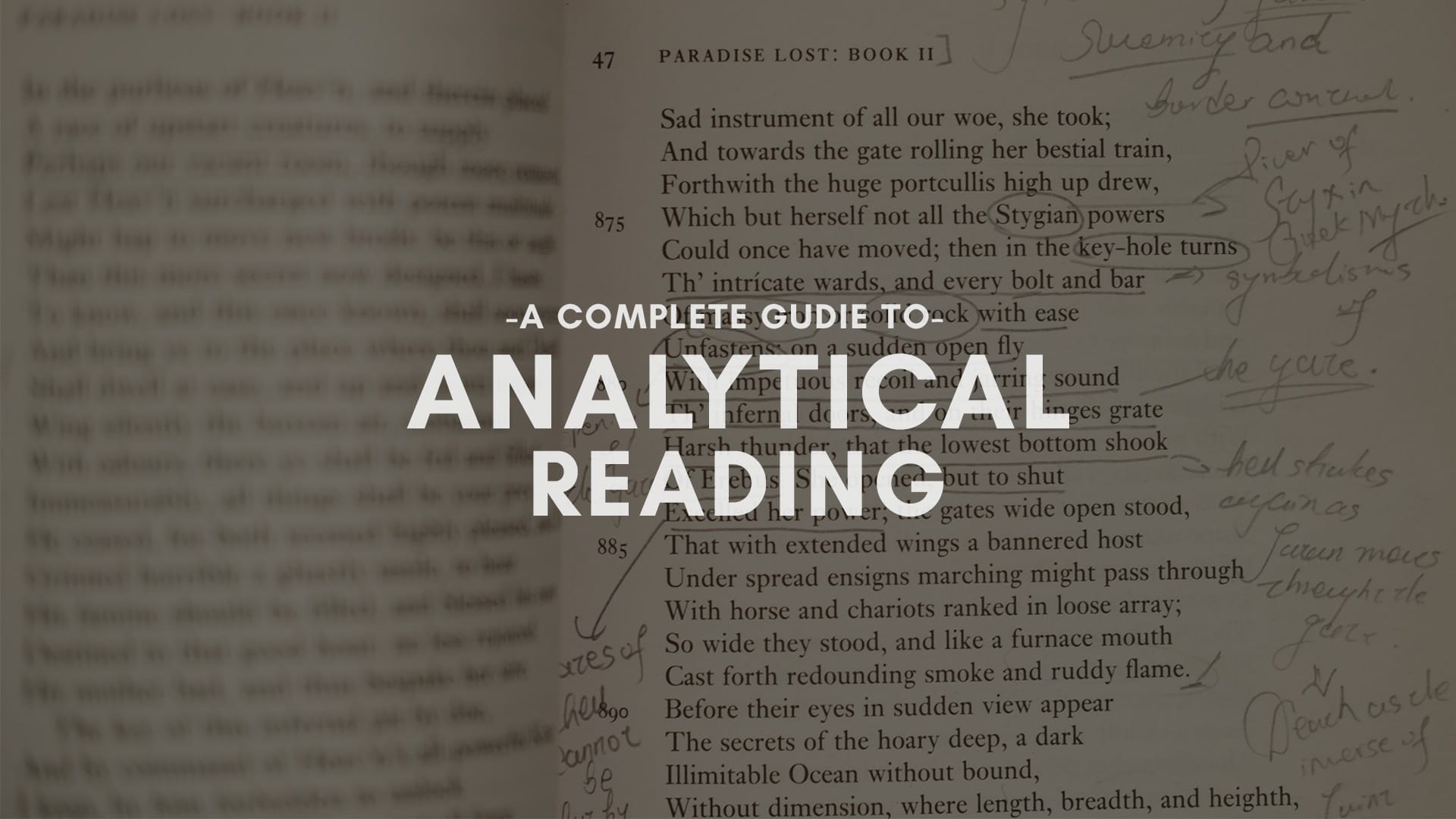
This workshop will take the key ideas from this letter and give you specific guidelines, annotation guides and worksheets to help you develop this skill. And the end goal here isn’t to stop at this skill alone, but to transform it into a reader’s intuition where terms, propositions and arguments will leap out from the page from a first reading.
I’m super excited for you to join us this month, and members of the Cold Brew tier will have access to all the material from our previous workshop (How To Curate Your Personal Curriculum) and the upcoming session (The 5 Master Keys To Exploring Fiction).
Your support makes sure that A Mug of Insights remains a 100% reader-supported newsletter so I can keep putting out quality writing + workshops without bending a knee to any sponsors. When you’re ready, click the button below to claim your early bird offer!
Thank you again for all your support! And I'll see you soon with another letter on Monday!
Robin
Get a free email course with 7 proven techniques to improve comprehension, retain what you read, and engage more thoughtfully with any book:
Member discussion