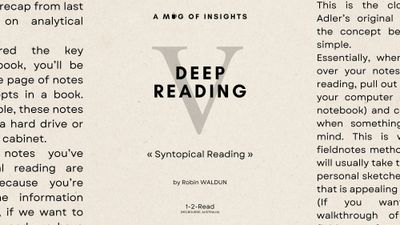
Deep Reading Pt. 4: Train Your Reader's Gaze In 7 Days
Most readers finish books. This is how you master them.

Welcome back to part 4 of our series on Deep Reading, and today we’ll tackle the most demanding stages of Adler’s system: analytical reading.
Again, all stages of reading in Adler’s system build on one another. By now, you should have a solid understanding of elementary reading & inspectional reading. Make sure to read both articles because today's concepts & exercises will refine skills you've developed there.
Also, if you want a practical workshop on the principles of analytical reading, I highly recommend ‘A Complete Guide to Analytical Reading’ and 'An Annotation Guide For Getting The Most Out of A Book'. These workshops will give you detailed demonstrations & worksheets, and they pair really well with this week's letter.
Mortimer J. Adler’s reading system pt. 4: analytical reading for non-fiction books
Reading a book is just like archaeological work, and they both look deceptively easy.
After watching hours of documentaries, we start to think that archaeology is all about unearthing perfectly preserved human remains, vases and golden sculptures.
And when we sit down to read a difficult book, we think that it’s possible to walk away with a complete understanding right away.
But experienced archaeologists and readers will smack you in the head, sit you down, and tell you that a complete understanding is often a result of piecing together related fragments.
So, if inspectional reading is about getting an overview of what we’re dealing with, analytical reading is the slow and patient process of breaking down the text into the right parts and putting them in the right places.
And just like archaeological work, there are specific protocols for piecing together fragments into a coherent whole. It starts with:
Subscribe to continue reading