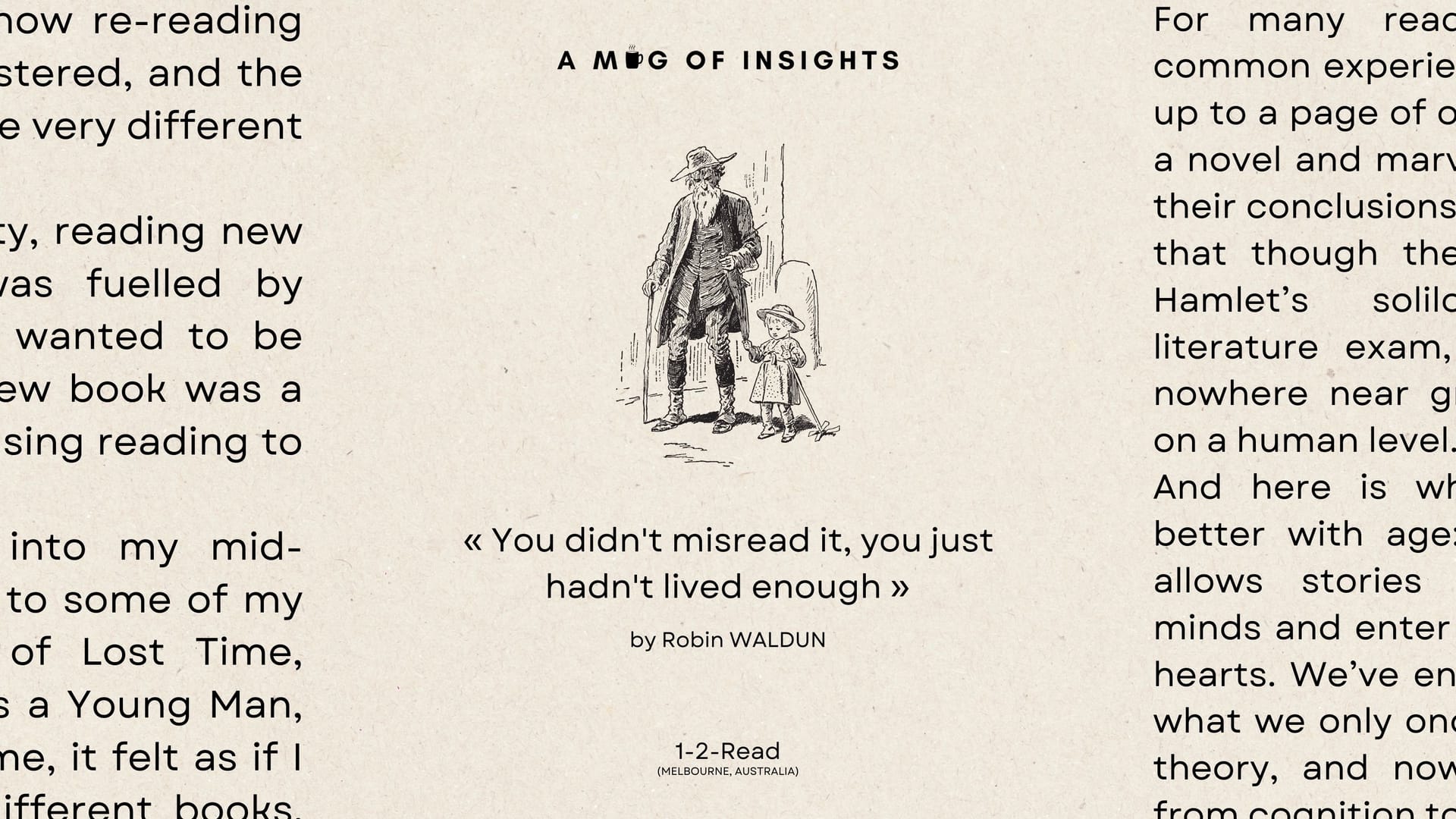
You didn't misread it, you just hadn't lived enough
I spend a lot of time now re-reading books I thought I’d mastered, and the experience proved to be very different to what I expected.
When I was in University, reading new works of literature was fuelled by frenzied excitement. I wanted to be well-read, and every new book was a fresh challenge. I was using reading to serve myself.
But as I’m stepping into my mid-twenties, I’ve returned to some of my favourites: In Search of Lost Time, Portrait of the Artist as a Young Man, The Waves, and this time, it felt as if I was reading entirely different books. Age has somehow made the descriptions more vivid, the dialogues more audible, and the characters more memorable.
For many readers, this is a common experience. They’ll open up to a page of old annotations in a novel and marvel at how stupid their conclusions were. They’ll see that though they’ve memorised Hamlet’s soliloquies for a literature exam, they were still nowhere near grasping the text on a human level.
And here is why reading gets better with age: life experience allows stories to bypass our minds and enter straight into our hearts. We’ve encountered in life what we only once understood in theory, and now, reading shifts from cognition to recognition.
In Byung-Chul Han’s book, The Agony of Eros, he writes:
“An insight preceded by experience is capable of shaking up the status quo in its entirety and allowing something wholly Other to begin.”
Reading fiction in this case is supercharged by life experience because it doesn’t offer more in theory but re-contextualises something we’ve already felt. And when this happens, we’ll cry at the opening of Thomas Wolfe’s Look Homeward, Angel. We’ll marvel at the genius of The Grand Inquisitor in Brothers Karamazov, and there’ll be no coming back. Reality has shifted because literature has permanently altered our perception. Whereas:
“Excessive cognition prevents recognition from taking place… [whereas a] transformative experience… often occurs only once.”
In other words, if we head into every book with an iron will to understand it, then we’ll miss out on the true transformative power of fiction. We won’t allow our experiences to intersect with descriptions of human nature out of pride, and as a result, we’ll walk away from dozens of great books still feeling like we have not changed.
(2) Reflections
1: Think of a book you read years ago and have since returned to. What did life teach you that the book couldn't? What did you recognise this time that you only once understood? Dedicate a page in your journal to writing about this shift from cognition to recognition.
2: Bring to mind another book you've dismissed or abandoned. Were you trying to master it or be moved by it? What would change if you returned to it with experience instead of a hurried frenzy to understand it?
If you've enjoyed this week's letter, you'll definitely find a lot of value in our deep dive on Monday, where we'll expand on this idea of cognition vs. recognition and how you can use it in your life to see the life-transforming qualities of literature.
To access all Monday deep dive articles, join The Double-Shot Tier for just $5/month.
As I’m writing this, A Mug of Insights is now fully funded by readers, for readers, and I’ve no intention to bring in sponsors who’ll muck up our work here. So, join me on this journey of building the best protocols & practices to become formidable readers:
Get a free email course with 7 proven techniques to improve comprehension, retain what you read, and engage more thoughtfully with any book:
Member discussion