
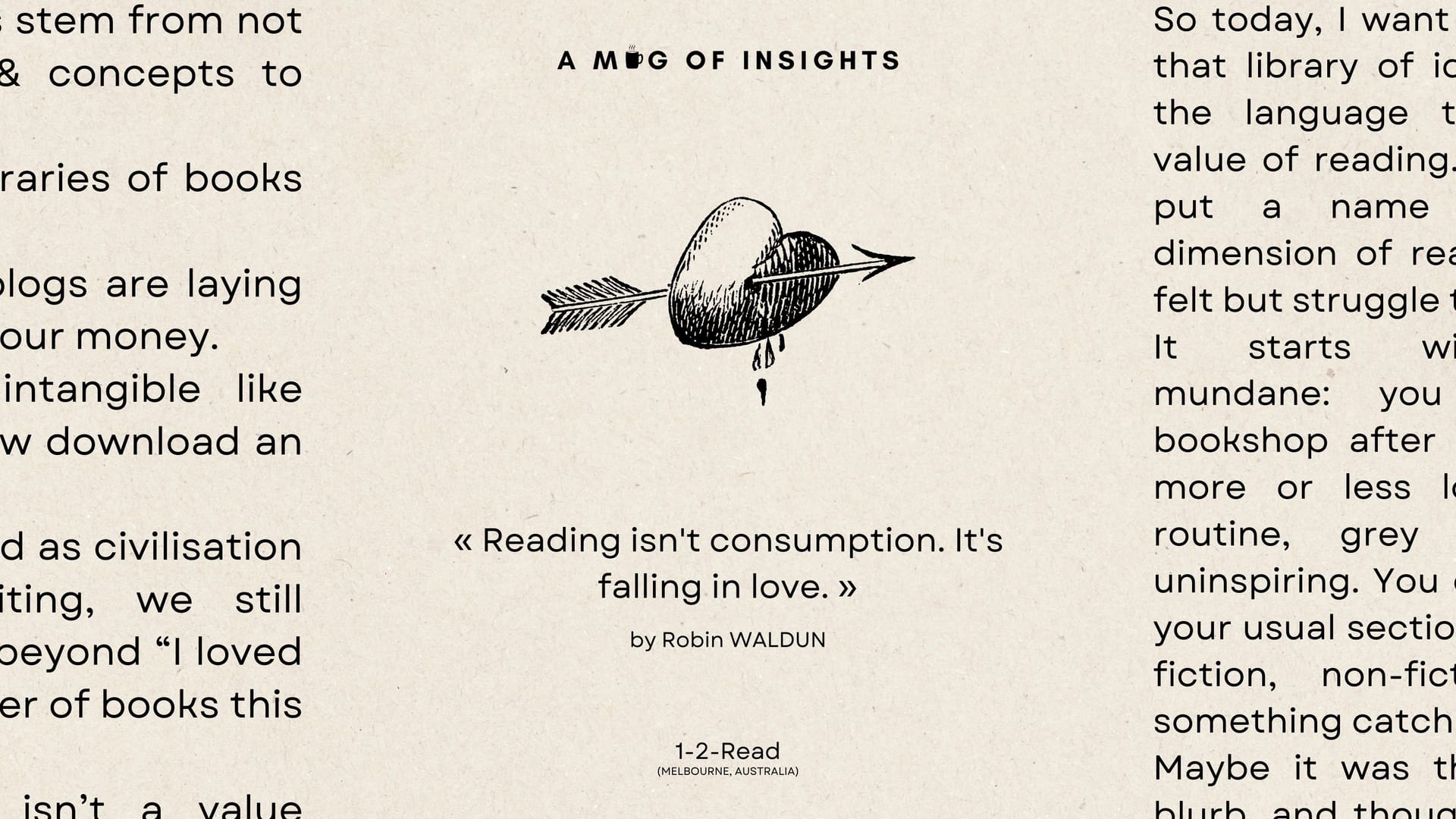
Reading isn't consumption. It's falling in love.
Many reading struggles stem from not having the language & concepts to guide us.
In fitness, there are libraries of books on dieting.
In finance, dozens of blogs are laying out paths to mastering our money.
Even for something intangible like meditation, you can now download an app for that.
But for something as old as civilisation itself: reading & writing, we still struggle to describe it beyond “I loved it!” or “I’ve read x number of books this year”.
What we have here isn’t a value problem, because everyone knows implicitly that they want to read more. The benefit of reading at this point is undeniable, especially if you’ve been engaging with my work. What we have here is an articulation problem. The people who have access to literacy simply take it for granted, whereas those of us who are still learning find it humiliating to ask for help.
So today, I want to start building that library of ideas to give you the language to describe the value of reading. This week, we’ll put a name to a deeper dimension of reading most have felt but struggle to articulate:
It starts with something mundane: you walk into a bookshop after work. The world more or less looks the same: routine, grey and a touch uninspiring. You do the rounds at your usual sections: new releases, fiction, non-fiction, but then something catches your eye…
Maybe it was the cover or the blurb, and though you know that you didn’t budget for it, something about this book makes you want to blow your bank account. You let all the usual constraints go, and there you are, walking out of the store with a brown paper bag.
This moment, according to the French philosopher Alain Badiou, is a random encounter. For him, this is the condition of love: an event that breaks us out of our usual patterns and propels us into discovery.
The world looks a touch more colourful now. On your drive home, you start to plan your evening around reading the book. I’ll get those emails out of the way, then send off that report, then I’ll dig in! And when everything’s in place: dinner, emails, feeding the dog, you open the book to the first page, and something magical happens.
For a few hours, you’re in a different world exploring ideas that are absent in your day-to-day life. Your brain slows down, and words start to turn into images, sensations and even sounds. And the best part of it usually comes after you’ve put the book away to walk your dog: reality looks a little bit different after you’ve fed your mind.
The usual walk down your apartment’s block looks a touch more vibrant. You look down at your dog like it’s the first time you’ve seen him at the rescue shelter. Even the usual nuisance of stopping at every other tree stops annoying you. The world seems a little different this time.
What happened there?
Let me introduce you to the first concept that’ll help us understand the value of reading: The Two-Scene. This is an idea by Alain Badiou in his book: In Praise of Love. For him, the experience of love isn’t merely possession (this book can give me something I lack). In fact, the real impact comes from co-creating a different reality with the book.
Badiou writes beautifully here:
“Love isn’t simply about two [subjects] meeting and their inward-looking relationship: it is a construction, a life that is being made, no longer from the perspective of One but from the perspective of Two.”
In other words, to fall in love with a book is to stop treating it as a cultural object that is there to serve our interests and proclivities. To love a book is to treat it as a living, breathing subject, capable of rewiring our relationship with the world. Reading isn’t consumption: it’s an active will to see reality anew when two worlds collide.
(2) Reflections
1: Think back to a time when a book transformed how you see reality. Write about this experience from three distinct moments: the encounter, the immersion and the shift. Be as specific as possible and start to appreciate the power of approaching reading from the Two-Scene.
2: Pick up a book that you’re struggling to finish. Could it be the case that you’re expecting something from it or trying to force yourself to understand it instead of letting the Two-Scene unfold? Reframe this experience and allow the book to breathe into how you think & act throughout the day, and see if your reading experience deepens.
There’s so much more to this idea of Two-Scene that I’m dying to explore with you. In fact, this was the subject of my thesis titled: Amorous Reading, and the frameworks I’ve laid out there have been at the core of my teaching for the last eight years.
So, after finishing this letter, you should have an intellectual understanding of this idea, but practising it is a different story.
That's what Monday's paid newsletter is for. It’ll take the ideas we’ve covered on Saturdays, crank it up to 100 and lay out specific exercises & protocols for you to implement into your life throughout the week.
If you want to move from understanding the Two-Scene to practising it, join The Double-Shot Tier for just $5/month.
As I’m writing this, A Mug of Insights is now fully funded by readers, for readers, and I’ve no intention to bring in sponsors who’ll muck up our work here. So, join me on this journey of building the best protocols & practices to become formidable readers:
,
Get a free email course with 7 proven techniques to improve comprehension, retain what you read, and engage more thoughtfully with any book:
Member discussion