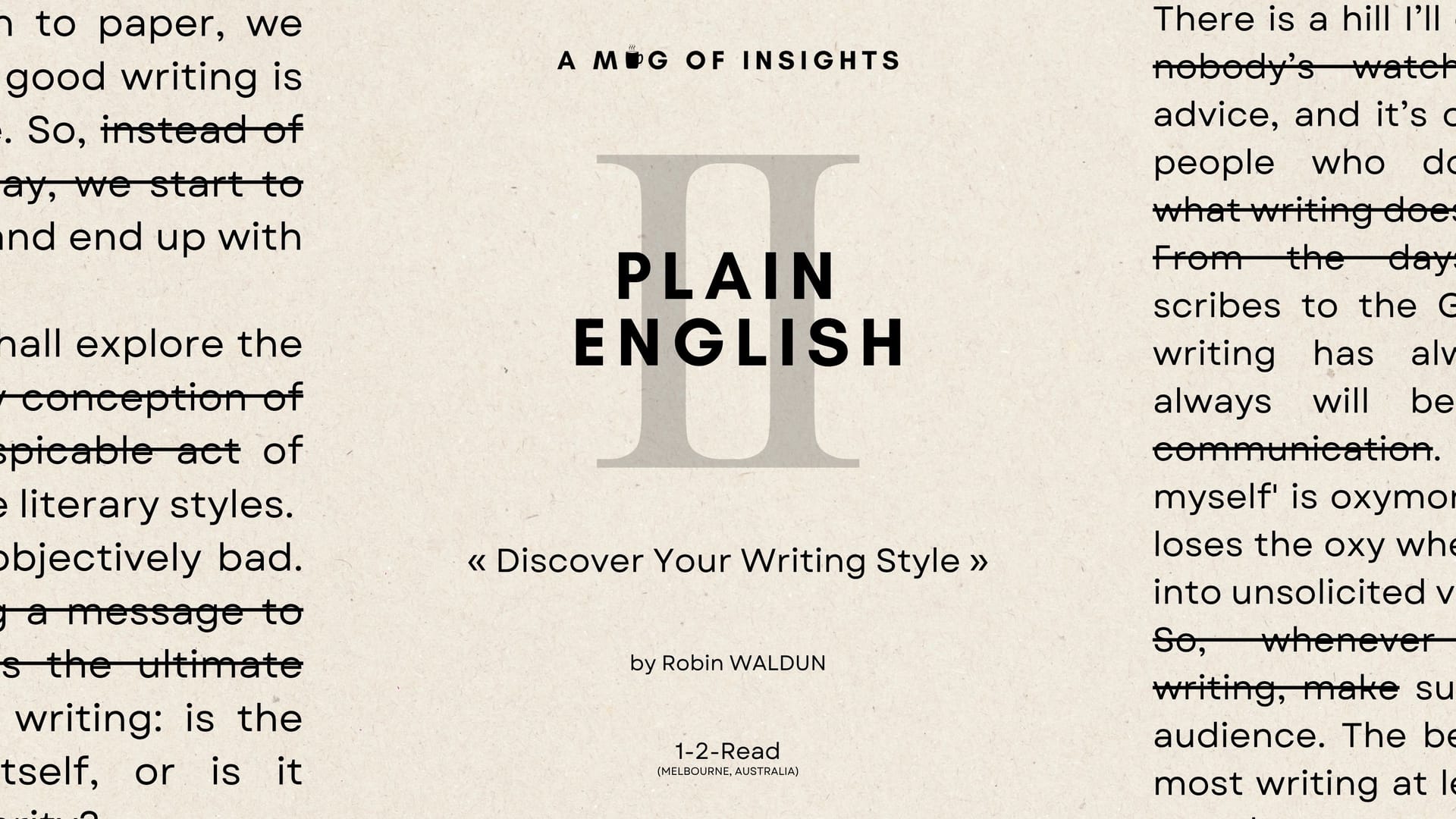
Plain English Pt. 2: The Secret to Finding Your Writing Style
Welcome back to part 2 of our series on Plain English, where I’ll teach you the stuff that works from an English degree without the jargon.
This week, we’ll focus on communicating with clarity and style in writing. If you haven’t read part 1 (on grammar), make sure to brush up on it because everything in this letter will build on the rules we’ve covered there. Once you have a basic idea of how to put together a clean sentence, let’s talk about style.
When we first put pen to paper, we have ideas about what good writing is supposed to sound like. So, instead of finding something to say, we start to worry about our voice and end up with something like this:
The following extract shall explore the intricacies of our shaky conception of language during a despicable act of puffing up words to ape literary styles.
This kind of writing is objectively bad. It’s not communicating a message to the reader, and this is the ultimate litmus test for quality writing: is the writing focused on itself, or is it communicating with clarity?
And that brings me to this week’s key reframe:
Style is a byproduct of communicating well, not something we actively discover.
In other words, if you find a way to turn jumbled thoughts in your head into understandable ideas on the page, then your work can’t help but carry your fingerprint. Your thought process is what gives your writing style & shape. So, the principles I’ll cover today are not just guidelines for writing with clarity, but a compass for better thinking.
Let’s start with:
0: Someone’s always reading
There is a hill I’ll die on: 'write like nobody’s watching' is terrible advice, and it’s often peddled by people who don’t understand what writing does.
From the days of monastic scribes to the Gutenberg press, writing has always been and always will be a vessel for communication. So, 'I write for myself' is oxymoronic at best and loses the oxy when people breeze into unsolicited verse.
So, whenever you practice writing, make sure to assume an audience. The best audience, for most writing at least, is a popular grandma or a twitchy nephew. Assume your audience is a reasonable reader, but also busy and distracted. Capture their attention, hold their hands through difficult ideas, and give them a reason to care.
Even better, try to write about a topic you know really well. Your prose will naturally bend to the shape of the topic, and your mind will look for ways to explain it clearly. Soon, you’ll see that the best writing usually comes from healthy constraints, and here are 8 of these to temper your style.
1: Provocation
Hemingway wrote:
Subscribe to continue reading