
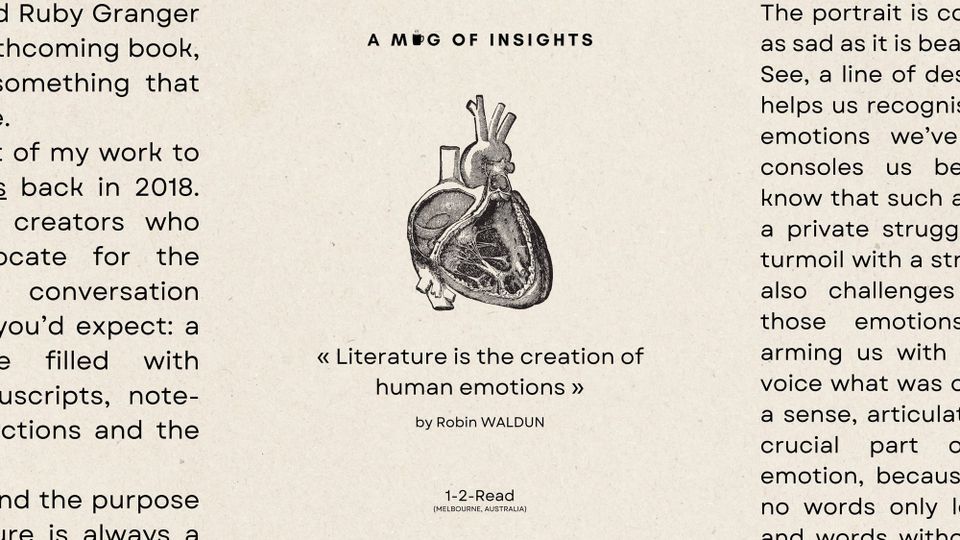
Literature is the creation of human emotions
The hidden purpose of reading people miss

Last week, I interviewed Ruby Granger for a chapter of my forthcoming book, and I want to share something that has stuck with me since.
For context, I owe a lot of my work to Ruby’s YouTube videos back in 2018. She was one of the creators who inspired me to advocate for the humanities, and our conversation unfolded exactly how you’d expect: a two-hour-long voyage filled with detours into old manuscripts, note-taking, rare book collections and the purpose of literature.
See, this question around the purpose of reading and literature is always a sensitive one. It’s opaque for beginners, and seasoned aficionados find it impossible to articulate. So, I asked Ruby: in the world of many competing sources of entertainment and knowledge, what makes literature so special?
And her answer was absolutely brilliant:
‘Literature/writing is special because it is the creation of human emotions.’
I immediately wrote it down in my notebook, and soon, I started to spot examples in everything I read.
For instance, one of my favourite descriptions in James Joyce’s Ulysses was a short scene in the episode ‘Lestrygonians’. In the story, Leopold Bloom’s wife was cheating on him, and apparently, the words had travelled far into the ears of Nosey Flynn:
‘– Ay, now I remember… Isn’t Blazes Boylan mixed up in it?’
Now, the novel portrayed Blazes Boylan as a sleazily womaniser, and Bloom’s heart was filled with jealousy and sadness while he was eating a mustard-filled sandwich. But instead of merely writing something like: Mr Bloom was jealous, Joyce rendered this emotion beautifully with:
‘A warm shock of air heat of mustard hanched on Mr Bloom's heart.’
Some critics have argued that this line is a physical description of Bloom eating a mustard-filled sandwich, but for those who have experienced jealousy, mustard-heat upon the heart might be one of the best ways to put it. And when you put it together with the following line:
‘His midriff yearned then upward, sank within him, yearned more longly, longingly.’
The portrait is complete, and it is as sad as it is beautiful to read.
See, a line of description like this helps us recognise and refine the emotions we’ve felt before. It consoles us because now we know that such an emotion is not a private struggle, but a shared turmoil with a stranger at a bar. It also challenges us to identify those emotions in ourselves, arming us with the language to voice what was once inaudible. In a sense, articulating emotion is a crucial part of creating an emotion, because emotions with no words only lead to isolation, and words without emotions are often used to deceive.
Literature, in this case, forces us to feel and articulate what we’ve felt, and as a result, our world is far richer with words charged with attempts to articulate truth.
So next time, when you’re struggling to see the point of reading literature, try to:
1: Imagine a world where you’re prohibited from reading anything. This reminds me of the terrifying world of Fahrenheit 451, where people have completely lost the ability to comprehend complex shades of emotions because they've been banned from reading. In reality, we're not too far off from the same world if we don't safeguard the safehouse of human emotions. So, bring to mind a period in your life when you feel spiritually impoverished, and see if a lack of reading had something to do with it.
2: Return to a book you’ve loved and isolate the parts that brought something up in you. This is how we can verify this process for ourselves: did a passage in literature give us the language to talk about our feelings? For me, the opening lines of Thomas Wolfe's Look Homeward, Angel, always bring tears to my eyes, and I recognised that it gave me the language to talk about the isolation I felt when I first read it. At the same time, those lines created and enhanced the emotions I felt in that moment. So, this week, find a passage that struck a chord and revisit the feelings that it has created for you.
7 core principles in grammar, style and rhetoric distilled into 7 lessons that'll change how you write forever
Member discussion