
A 300-Year-Old Journaling Method That Still Works
Housekeeping: we’ll be taking a short break next week during the Easter long weekend, and we’ll be back with part 3 of our Plain English series on the 13th of April.
This will give me some time to finish setting up our new community, and I’ll announce April’s live workshop next Saturday. Thank you for your continued support, and I’ll see you soon with more!
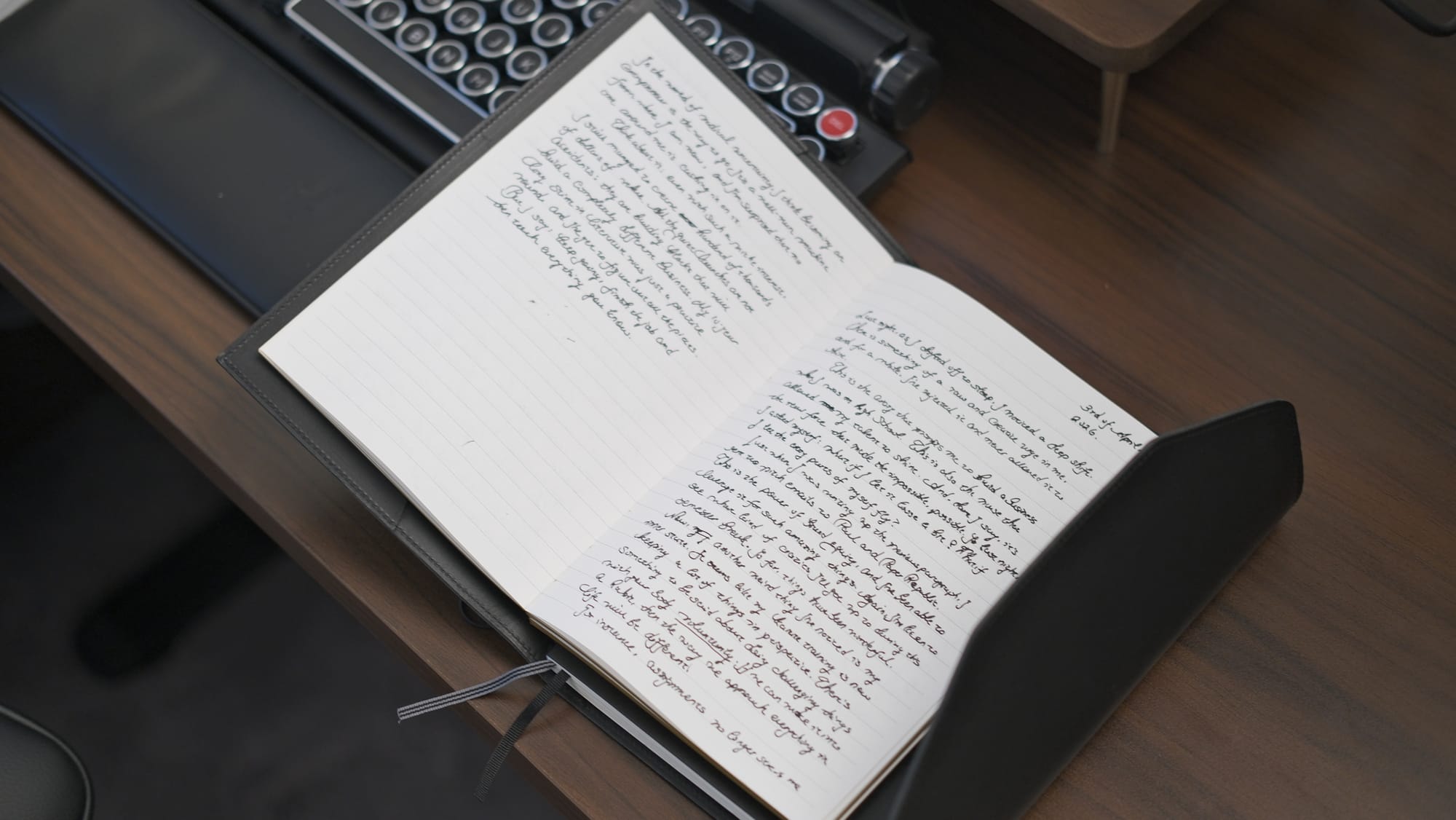
Last week, the amazing team at Paper Republic sent me their Trifold notebook from Vienna. And as a seasoned notebook hoarder, I saw this as an opportunity to start a new journaling practice.
Since September 2025, I’ve used a mind-dump method, filling up 3 pages with whatever comes to mind. This worked for a year, and I’ve filled up 4 notebooks with jumbled musings, but I think I’ve hit a glass ceiling.
See, merely journaling our thoughts is a game of diminishing returns. At some point, we’ll keep journaling about the same things with no revelations. We’ll keep repeating the same narratives without seeing where we’re at in life. When this becomes a routine, journaling turns into an unhealthy self-mythologisation, not a tool for growth.
Whereas real insights and personal growth come from looking outward. It’s about documenting, with honesty, who we are instead of painting a portrait of who we think we are. It’s also about documenting our real-time reactions to life events while asking: Why do we feel that way? Is it justified? And is this something we’d like to change?
This brings me to a book I’ve been reading: The Life of Samuel Johnson by James Boswell. For context, James Boswell compiled his journals as the first draft of this book, and his genius shines from how he portrayed his subject: Dr Samuel Johnson.
Boswell wrote in the opening chapter:
‘The business of the biographer is often to pass slightly over those performances and incidents which produce vulgar greatness, to lead the thoughts into domestick privacies, and display the minute details of daily life, where exteriour appendages are cast aside, and men excel each other only by prudence and by virtue.’
In other words, Boswell didn’t want to write another story about a great man, or in his words, 'those performances and incidents which produce vulgar greatness'. His goal was to dive headfirst into the raw ingredients of Samuel Johnson’s life: domestic squabbles and ordinary errands. And as I’m reading this book, these seemingly mundane moments are a lot more enjoyable to read than a list of crowning achievements.
Yet, when I re-read some of my journal entries from last year, all I found were moments of heroic struggles, dramatic interludes, and bursts of achievements. And it saddened me that I had no records of listening to music in my room, or that one time when sensei and I chased a mantis out of the dojo with a broom. I had ignored all the mundane moments that made up the substance of a year well-lived.
So, as I’m breaking into this new journal, I’ll make a deliberate effort to use journaling as documentation. I want to leaf through my old entries with a smile on my face, knowing that I wasn’t stuck in my head when beautiful moments passed me by.
(2) Reflections
1: Audit your latest journal entry. Does it capture the texture of your everyday life? Or is it just a jumble of thoughts? Are you paying attention to the details that make up your everyday experiences? If not, interrogate your relationship with your journal and consider:
2: Journal like Boswell for a week. James Boswell was famous for his riveting journal entries, and his writing naturally bends to the stories & characters in his life. For the next 7 days, try to find one striking event, one character and one revelation to centre your writing around. Notice that entries like these are easier to write, and even better to re-read. After you’ve done this for 7 days, review the entries and feel the difference.
Get a free email course with 7 proven techniques to improve comprehension, retain what you read, and engage more thoughtfully with any book:
Member discussion